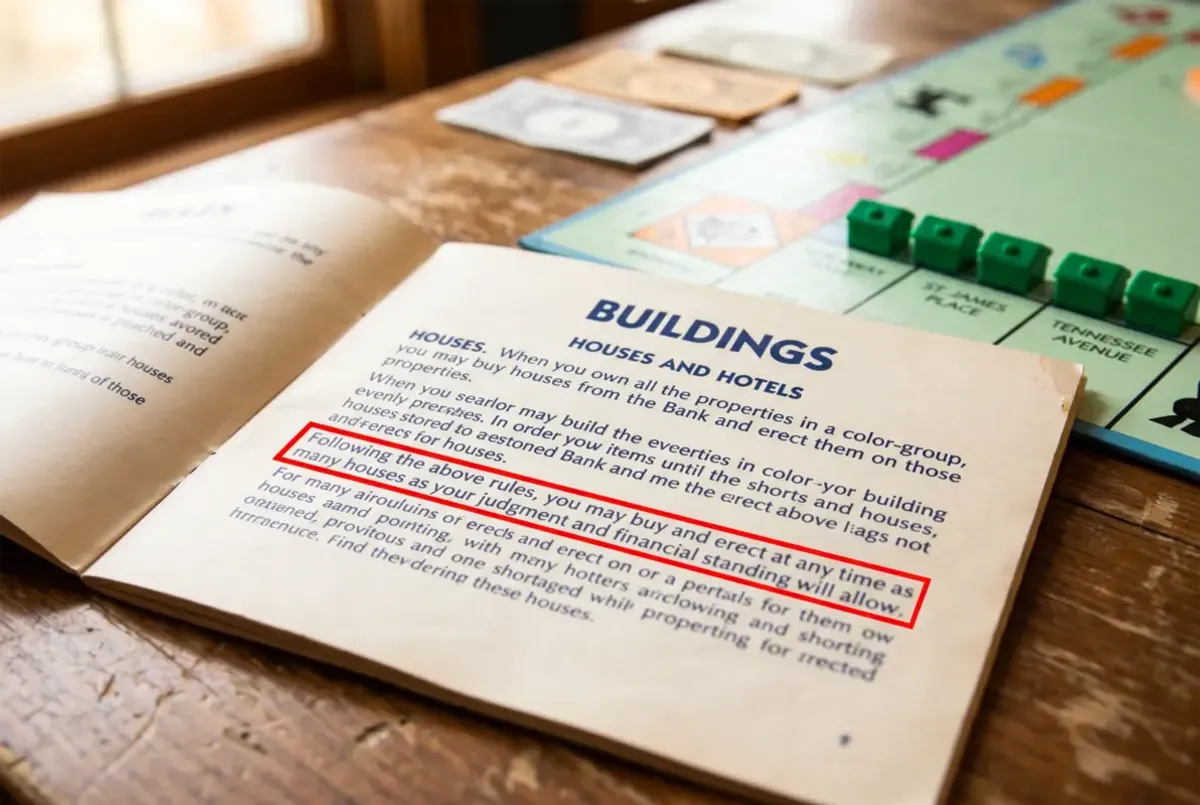
You can buy houses at any time — that is the direct answer to when can you buy houses in monopoly. Not on your turn only. Not after rolling. Any time you own a full color set and have the cash, you can build.
Nothing destroys a game night faster than someone dropping a hotel on Boardwalk right before you roll — and most tables have no idea you could have built that house three seconds earlier, legally, on someone else’s turn.
I learned the timing rule the hard way at a college game night. My roommate landed on my Tennessee Avenue with two houses, owed me $780, and I watched him reach for his wallet — then my other roommate slapped a third house on St. James Place during that same turn, before the rent was collected. The table exploded. We pulled out the rulebook. He was right. I had been playing wrong for fifteen years.
In this guide, we break down the official Hasbro manual so you can stop arguing and start building. You will learn the exact monopoly rules houses and hotels fall under, what monopoly house building rules require, how much do houses cost in monopoly, and the housing shortage tactic tournament champions use.
Table of Contents
- The Short Answer: When Can You Buy Houses in Monopoly?
- The Core Monopoly House Building Rules
- How Much Do Houses Cost in Monopoly?
- Upgrading: Official Monopoly Hotel Rules
- The “Housing Shortage” Expert Strategy
- Your Next Move
The Short Answer: When Can You Buy Houses in Monopoly?
Someone at every game night asks me: when can i buy a house in monopoly? The official answer shocks anyone who only plays casual family rules.
According to the Hasbro manual, you can buy houses at any time. Before you roll. After you roll. In the middle of someone else’s turn. The Bank does not care whose dice are hot.
So in monopoly can you buy houses at any time during the game? Yes — with one non-negotiable condition: you must own every property in that color group. A complete monopoly. One orange deed does nothing. All three oranges unlock building.
Key Terms to Know
- Color group — A full set of same-color properties (e.g., all three Orange: St. James Place, Tennessee Avenue, New York Avenue).
- Even-build rule — You must add houses evenly across the set. No stacking three on one lot while another sits bare.
- Title Deed — The card that lists purchase price, rent at each house level, and house/hotel cost.
Tactic 1: Build Before They Roll
Here is how monopoly when can i buy houses at any time becomes a weapon:
- Watch an opponent’s token approach your developed color group.
- Before they pick up the dice, announce you are buying a house in monopoly on the space they are likely to hit.
- Pay the Bank, place the house, and wait.
- If they land there on that roll, they owe the upgraded rent immediately.
I did this to my brother on New York Avenue last Christmas. He was two spaces away, reaching for the dice. I dropped a third house. He landed, saw the rent jump from $280 to $780, and put his head on the table. Legal. Brutal. Exactly what the rules allow.
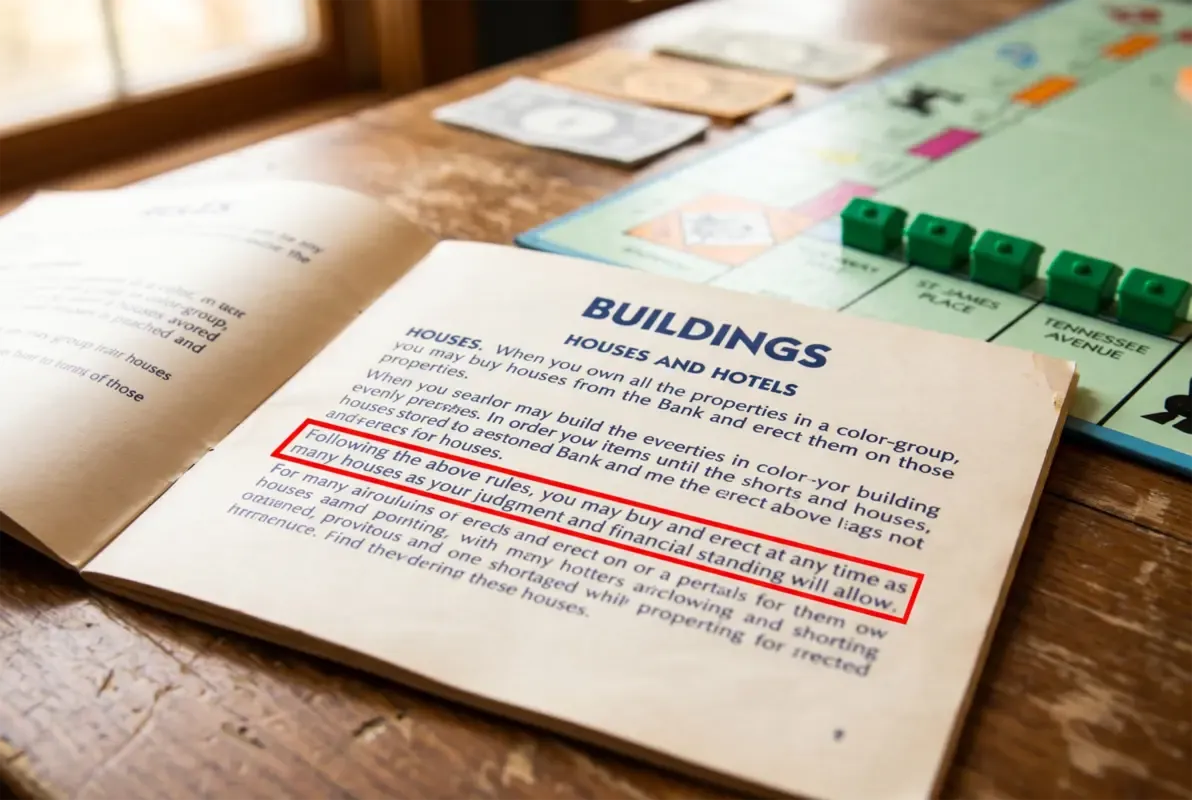
Worth knowing: you can also build from Jail. Being locked up stops your movement — not your right to develop. Tournament players buy houses from behind bars constantly.
👉 Further Reading: Monopoly strategy hub — property picks and win-rate tactics
The Core Monopoly House Building Rules
Owning a full color set is step one. The monopoly rules for buying houses do not let you dump everything onto a single property and call it a fortress.
Before you buy a single house, understand the even-build rule. You cannot place a second house on Pennsylvania Avenue until every Green property has one house. You cannot jump to three houses on one lot while another in the same group has one. Build in waves — one house per property, then the second round, then the third.
These monopoly house building rules keep one space from becoming an unstoppable death trap while the rest of the group stays worthless. The rent tables on each Title Deed assume even development — that is how the math was designed.
My uncle ignores this every game. He stacks four houses on Boardwalk while Park Place sits empty. We always let him — then we beat him, because his rent ceiling is lower than a balanced three-house set across both Dark Blues would be. The rule exists for a reason.
Key Terms to Know
- Monopoly (color set) — Owning all properties in one color group; required before any building.
- Mortgaged property — Cannot collect rent or participate in building on that deed until unmortgaged.
- Bank supply — Only 32 green houses exist in the box; when gone, building stops for everyone.
Tactic 2: Build in Even Waves
Here is exactly how to stay legal under the even-build rule:
- Place one house on every property in the color group before adding a second anywhere.
- Count houses aloud — all three (or two) lots must match before the next round.
- Never skip a lot because it “does not get landed on as much” — uneven builds violate official rules.
- Check that no deed in the set is mortgaged before paying the Bank.
| Rule | Requirement |
|---|---|
| Own full color group | All deeds in the set, none mortgaged |
| Even-build | Same house count on every property before adding the next level |
| Buy timing | Any time — your turn, between turns, from Jail |
| Bank supply | Only 32 houses in the box — when gone, no one builds |
| Hotels | Four houses per property first, then upgrade |
👉 Further Reading: Monopoly rules jail — build houses from behind bars
How Much Do Houses Cost in Monopoly?
Real estate prices depend on where your properties sit on the board — not some separate price list.
At nearly every tournament I have attended, someone asks how much do houses cost in monopoly compared to the property purchase price. The answer is printed on the bottom of every deed card. No guessing, no house rules.
Here is how much are houses in monopoly by board side:
Key Terms to Know
- House cost — The price printed on each Title Deed for adding one green house; varies by color group.
- Board side — Which edge of the square board a property sits on; determines house price tier.
- Rent multiplier — Each house level multiplies base rent on the deed card — development pays off fast on high-traffic groups.
| Board Side | Color Groups | House Cost |
|---|---|---|
| First side | Brown, Light Blue | $50 per house |
| Second side | Pink, Orange | $100 per house |
| Third side | Red, Yellow | $150 per house |
| Fourth side | Green, Dark Blue | $200 per house |
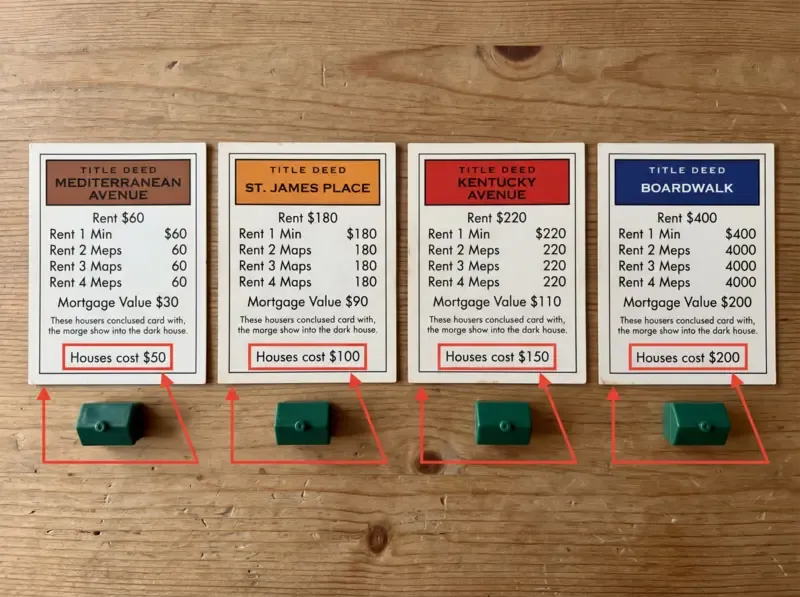
Knowing how much are the houses in monopoly shapes your opening moves. If you read our starting money guide, you know everyone opens with $1,500. Six $50 houses on the Light Blues cost $300 total — a cheap way to spike rent early while you still have cash to buy unowned properties on later laps.
👉 Further Reading: Monopoly economics hub — rent math and ROI analysis
Upgrading: Official Monopoly Hotel Rules
The endgame goal is replacing green houses with red hotels. But you cannot skip the ladder.
Under standard monopoly hotel rules, you cannot buy a hotel outright. Every property in the color group needs exactly four houses first — evenly, per the build rule. Then you pay the Bank one more house price, return all four green houses to the supply, and place one red hotel on that property.
Those monopoly house and hotel rules recycle houses back into the Bank. Upgrading to a hotel on one property frees four houses for someone else — which matters when the supply runs thin.
One hotel per property maximum. Once the red hotel is up, that space is fully developed. Rent jumps to the top tier on the deed card.
Key Terms to Know
- Hotel upgrade — Replacing four green houses on one property with one red hotel after paying one additional house cost.
- House return — All four green houses go back to the Bank when a hotel is placed — freeing supply for other players.
- Fully developed — A property with one hotel; no further building possible on that space.
Tactic 3: Upgrade Only When It Pays
Hotels free houses back to the Bank — but they also signal your endgame. Build to hotels when:
- You want maximum rent on a high-traffic color group (Orange, Red).
- You need to return houses to the supply so you can develop a second monopoly.
- The board is late-game and opponents are low on cash — hotel rent forces bankruptcies.
Hold at four houses instead of upgrading when you are running a housing shortage strategy to block opponents.
Note: You can verify the exact hotel upgrade wording on the Hasbro PDF, the Monopoly Wikipedia page, or through the Hasbro Consumer Care portal.
👉 Further Reading: Monopoly starting money distribution — plan your $1,500 around early house buys
The “Housing Shortage” Expert Strategy
There is one tactic that separates casual tables from players who have read the fine print. It exploits a physical limit in the box — not a house rule.
The official monopoly rules house buying section is clear: the game includes only 32 green houses and 12 red hotels. When the houses are gone, nobody builds. Period.
Key Terms to Know
- Housing shortage — When all 32 green houses are on the board or held by players; no further house purchases allowed.
- House hoarding — Deliberately keeping four houses on cheap sets without upgrading to hotels to lock the supply.
- Supply recycle — Upgrading to a hotel returns four houses to the Bank — the main counter to a shortage.
Tactic 4: Trigger the Shortage on Purpose
Here is the play:
- Secure a cheap monopoly early — Light Blue or Brown is ideal.
- Build evenly to four houses on every property in that group.
- Stop. Do not upgrade to hotels.
- Repeat on a second cheap set if cash allows.
- Watch the Bank run dry while opponents hold expensive Green or Dark Blue monopolies they cannot develop.
Twelve houses sitting on Mediterranean and Baltic while Park Place sits naked? That is not griefing — that is legal under the supply rules. I watched a player at a regional tournament lock up all 32 houses by turn 40. The eventual winner had not built a single hotel all game. The room went silent when someone counted the Bank tray.
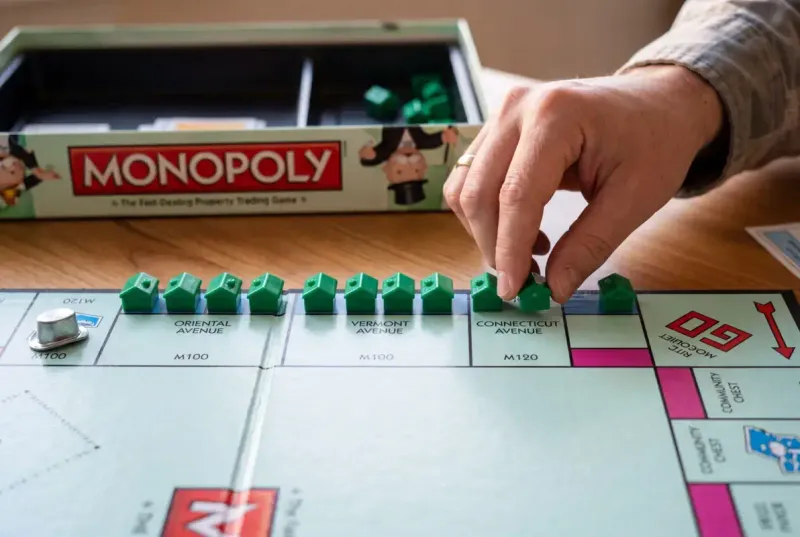
The counterplay: upgrade to hotels on your own sets to return houses to the supply, or mortgage deeds you are not developing to raise cash for a building race.
👉 Further Reading: Monopoly strategy hub — win-rate tactics and property timing
Your Next Move
You now know when can you buy houses in monopoly — any time, with a full set, built evenly.
Your first step at the next game night: rush a cheap monopoly like the Light Blues. Do not wait for your turn to build. The moment you own all three and have $150 in the bank, start dropping $50 houses — especially right before an opponent rolls toward your block. Use the rules to your advantage and watch their faces drop when they owe double the rent.
For the full rules picture — setup cash, jail, auctions, and mortgages — visit our Monopoly Rules Hub or the complete Monopoly guide.
Have you ever used the housing shortage to win? Leave a comment on the Contact page and let us know!
Subscribe to The Dice & Deeds Briefing for rule updates, building tactics, and new guides from Dice and Deeds.
Questions
Frequently Asked Questions
When can you buy houses in Monopoly?
At any time — not only on your turn. Official Hasbro rules let you buy houses before you roll, after you roll, or during another player's turn, as long as you own every property in that color group and follow the even-build rule.
Can you buy houses at any time in Monopoly?
Yes, under official rules. You do not have to wait for your turn. The only requirement is owning a complete color monopoly (all properties in that color group) and building evenly across those properties.
Can you build houses while in Jail?
Yes. Official Hasbro rules allow buying houses and hotels from Jail on your turn or between other players' turns, as long as you own a complete color set and follow the even-build rule.
How much do houses cost in Monopoly?
House prices are printed on each Title Deed card. Brown and Light Blue properties cost $50 per house, Pink and Orange $100, Red and Yellow $150, and Green and Dark Blue $200.
Can you buy a hotel without four houses first?
No. You must have exactly four houses evenly built on every property in the color group before upgrading. You then pay for one more house, return the four green houses to the Bank, and place one red hotel.
What happens when the Bank runs out of houses?
No player can buy more houses until someone sells back to the Bank or upgrades to a hotel. This housing shortage is a deliberate tournament strategy — hoard houses on cheap sets to block opponents from developing expensive ones.