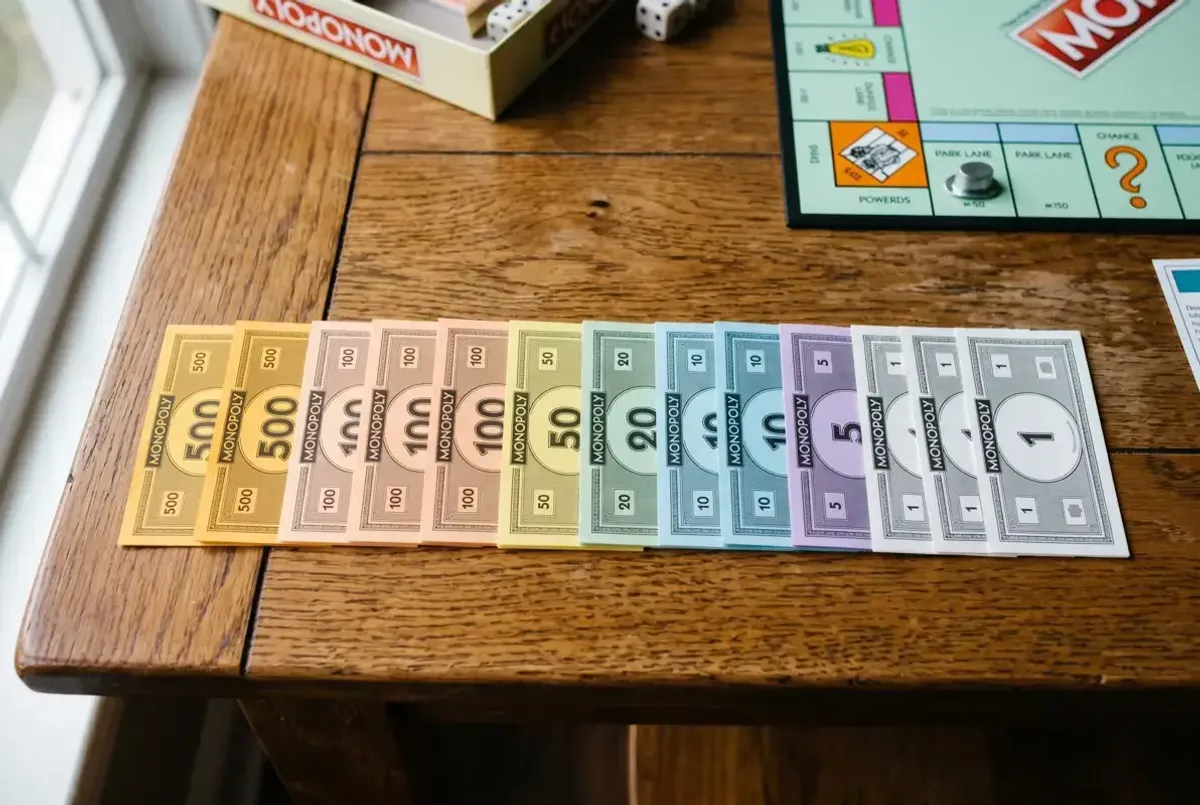
Every player starts with exactly $1,500 — that is the straight answer to how much money do you start with in monopoly. No exceptions, no house-rule shortcuts, no extra cash because only three people showed up.
I’ve still watched groups burn ten minutes arguing about it. Last Thanksgiving my nephew counted his stack, came up $200 short, and nearly quit before turn one — he had tucked two $100 bills behind his property cards and forgot they counted. The total was right; his pile was just scattered. The denomination split trips up even people who have played for years.
Below is the official monopoly starting money distribution, bill-by-bill: the full breakdown, a banker setup that prevents mid-game fights, and the monopoly starting cash rules everyone argues about before the first dice roll.
The Short Answer: How Much Money Do You Hand Out In Monopoly?
Before anyone picks a token, the Bank must fund every player.
So how much money do you hand out in monopoly? According to the official Hasbro instructions, each player receives exactly $1,500.
That total never changes. The starting money in monopoly per person stays at $1,500 whether you are playing a two-player duel or a six-person family marathon. Everyone begins on equal footing — no bonus cash for smaller groups, no penalty for larger ones.
The Official Monopoly Starting Money Distribution
Hitting $1,500 requires a specific mix of bills. Figuring out how much of each bill in monopoly goes to each player is where most setup arguments start.
Someone at every game night asks me the same thing: how many 500 bills do you start with in monopoly? Exactly two. Hand out three or four high-value notes and you inflate the early economy — properties sell out too fast and the game drags for hours.
Why two $500s instead of one $1,000 or six singles? Hasbro never published a design memo, but the split forces early friction in a way one big bill does not. Two high-value notes mean you are making change by turn three — trading bills with the Bank, breaking a $500 when someone lands on a $280 rent. That keeps cash moving. A single oversized note lets a cautious player sit on dead money while the board empties. The two-bill split is not arbitrary; it shapes how the first twenty minutes play out.
The official breakdown from the Hasbro rulebook:
| Bill Value | Quantity Per Player | Total Value |
|---|---|---|
| $500 Bill | 2 | $1,000 |
| $100 Bill | 4 | $400 |
| $50 Bill | 1 | $50 |
| $20 Bill | 1 | $20 |
| $10 Bill | 2 | $20 |
| $5 Bill | 1 | $5 |
| $1 Bill | 5 | $5 |
| GRAND TOTAL | 16 Bills | $1,500 |
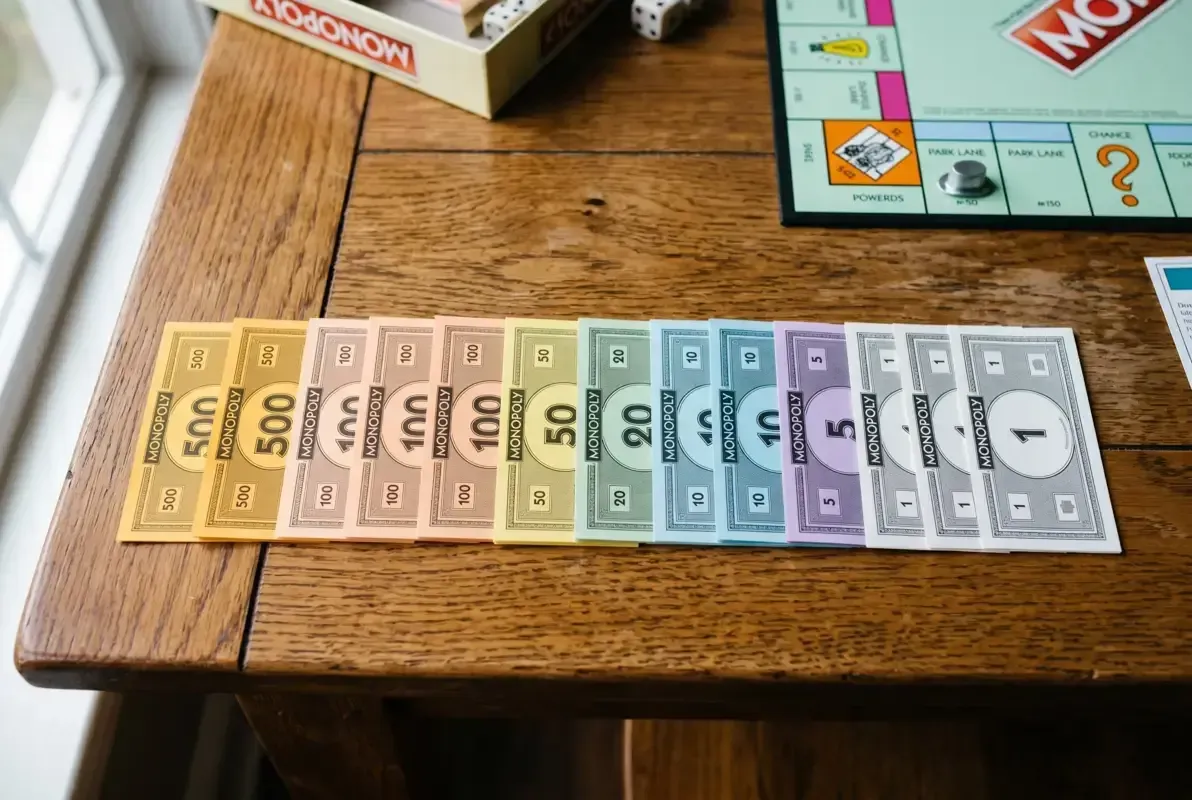
Sixteen bills per person. Count them once, deal them top-down, and you are done.
My sister shortcuts this every time — she grabs a random wad from the bank tray and says “close enough.” By the third lap around the board someone is $50 short and convinced the Banker stole from them. Close enough at setup becomes a lawsuit by Baltic Avenue. If your group plays often, laminate a copy of this table and tape it inside the box lid. Your future self will thank you.
Standard Sets vs. Monopoly Money Distribution 2026
Unboxing a themed edition and checking the monopoly money distribution 2026 insert? Do not panic if the bills look nothing like classic Monopoly currency.
Modern versions — Super Mario, Star Wars, Fortnite — sometimes swap paper bills for cardboard coins or simplified denominations. A Mario set might use 10s and 50s instead of the full $1–$500 range. Always read the specific instruction sheet inside the box.
For any classic or standard Atlantic City board, though, the $1,500 rule holds. Themed packaging changes the art, not the math.
Further reading: Editions hub — Classic, Deluxe, themed, and collector sets compared.
How to Pass Out Monopoly Money (Banker Setup Guide)
A messy bank leads to miscounts, accusations of theft, and games that never really start. Five minutes of organization saves an hour of arguing.
In my family, my dad has been the Banker since 1998. He will not roll dice until every denomination is squared in the tray and every player has fanned their stack on the table. Annoying? A little. But we have never had a setup dispute in twenty years — and I have seen other groups implode before someone even passes Go.
Here is how to pass out monopoly money before the first roll:
- Pick a competent Banker. Choose someone comfortable with quick addition. The Banker plays too, but their personal cash must stay completely separate from the Bank’s funds.
- Sort the tray. Stack bills by denomination in the plastic banker’s tray — $500s on the left, cascading down to $1s on the right. This is the core of proper monopoly money setup.
- Deal top-down. Distribute backwards: two $500s first, then four $100s, then work down to the $1 bills. High denominations first prevents bills sticking together and throwing off your count.
- Verify the total. Each player should have 16 bills worth $1,500. A quick fan of the stack catches most errors before play begins.
The stack trick: experienced Bankers do not count sixteen individual bills per player. They deal in three piles — a $1,000 stack (two $500s), a $400 stack (four $100s), and a $100 stack (everything smaller: one $50, one $20, two $10s, one $5, five $1s). Three piles, one glance, done. I learned this at a local tournament where the judge dealt four players in under ninety seconds. Count stacks, not singles.
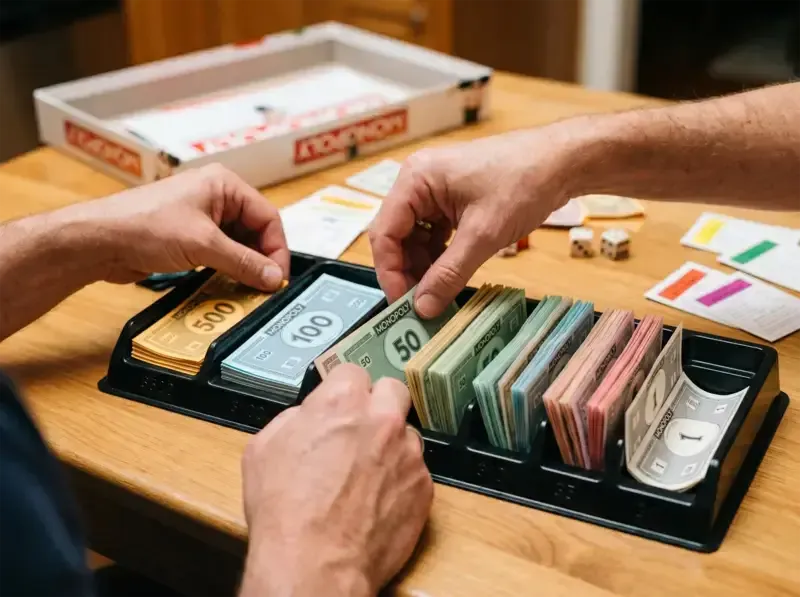
The Banker also manages houses, hotels, Title Deeds, and auctions. Keeping the cash tray organized at the start makes every transaction smoother for the rest of the game.
Further reading: How to win at Monopoly — property picks, trading tactics, and when to build houses.
Frequently Asked Questions: Monopoly Starting Cash Rules
Even after setup, cash questions surface in the first few turns. These are the official monopoly starting cash rules — verified against the Hasbro PDF and Wikipedia’s Monopoly entry.
Can the Bank run out of money?
No. The Bank never goes bankrupt under official rules. If the Banker runs out of physical bills mid-game, they write amounts on paper as IOUs until the Bank can make change. You can confirm this on the Hasbro Consumer Care portal or in the rulebook’s Banking section.
Do you get extra starting money with fewer players?
Never. Two players still get $1,500 each — same as six. Injecting extra cash into a small game makes properties too cheap to acquire and extends play time without adding strategy.
Do you put $500 in the middle for Free Parking?
Absolutely not — at least not under official rules. Free Parking is a neutral rest space. No money is awarded there. The jackpot house rule is widespread, but it breaks the game’s economy by recycling cash that should leave circulation. See our Monopoly FAQ for more house rules that change the game.
What if we are short on $1 bills?
The Bank can make change at any time. If you are genuinely out of a denomination, the IOU rule applies — write it down, track it, and settle when bills free up. In practice, a full box has plenty of cash for a standard four-player game.
Your Next Move
Bank organized, cash distributed, tokens chosen — time to play.
Your first strategic priority: aim for the Orange property group (St. James Place, Tennessee Avenue, New York Avenue). Players leaving Jail land on those spaces more than almost anywhere else on the board. That $1,500 buys a lot more when you snag Orange before anyone else does.
For the full rules picture — auctions, mortgages, and jail — visit our Monopoly Rules Hub or the complete Monopoly guide.
Who usually plays the Banker in your family? Tell us on the Contact page — we feature reader stories in future guides.
Subscribe to The Dice & Deeds Briefing for rule updates, strategy notes, and new guides. No spam — just occasional tabletop tips from Dice and Deeds.
Questions
Frequently Asked Questions
How much money do you start with in Monopoly?
Every player starts with exactly $1,500 in standard Monopoly. The official breakdown is 2×$500, 4×$100, 1×$50, 1×$20, 2×$10, 1×$5, and 5×$1 — 16 bills total per person.
How many 500 bills do you start with in Monopoly?
You start with exactly two $500 bills. That is $1,000 of your $1,500 total. Handing out extra $500s at setup is a common mistake that breaks the game's economy.
Can the bank run out of money in Monopoly?
No. Official Hasbro rules state the Bank never goes bankrupt. If physical bills run out, the Banker writes IOUs on paper until more cash is available.
Do you get extra starting money if playing with fewer people?
Never. Each player receives $1,500 regardless of group size — two players or six. Adding extra cash in small games makes properties too easy to buy and drags the game out.
Do you put money in the middle for Free Parking?
Not under official rules. Free Parking is a neutral rest space with no payout. The jackpot house rule is popular but not part of standard Hasbro play.