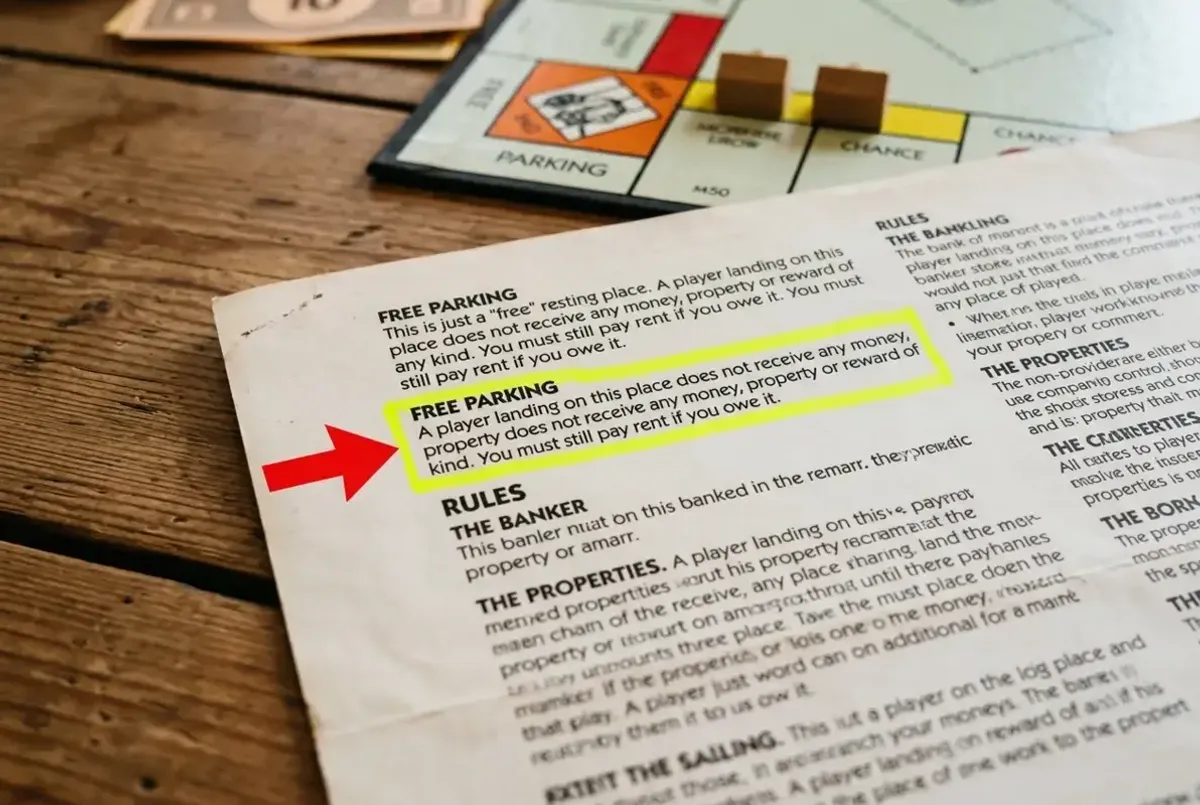
No — you get zero dollars when you land on Free Parking under official Hasbro rules. That single answer ends most table fights before anyone reaches for the pile of cash in the center.
I’ve watched my cousin Dave scoop up $2,400 from the middle on a Christmas Eve game while my aunt insisted it was “how we’ve always played.” The rule sheet in the box said otherwise. Nobody had opened it in fifteen years.
Below you’ll find the real free parking monopoly rules, where the jackpot myth came from, and why playing by the book actually shortens your game night — verified against the official Hasbro rulebook (PDF).
The Short Answer: Do You Get Money on Free Parking?
The argument almost always starts the same way. Someone lands on the corner, grabs the center stack, and someone else yells cheat.
Under official Hasbro rules, you do not receive any money for landing on Free Parking.
No jackpot. No bonus. No payday. If a player demands cash for resting on that square, they are wrong — full stop.
When people ask how much do you get for free parking in monopoly, the math is brutally simple: $0. Every time. The Hasbro manual is explicit.
Key Terms to Know
- House Rules: Unofficial tweaks families invent to spice up game night — like stuffing fines into the center of the board.
- The Jackpot: The colorful pile of bills players build in the middle when taxes and fines get recycled instead of returning to the Bank.
- Cash Drain: The deliberate design choice that pulls money out of circulation through taxes, fines, and rent — forcing mortgages and bankruptcies.
Prove It With the Rulebook
When my uncle swears the corner space pays out, I skip the lecture and open the box:
- Pull the physical instruction sheet (or open the Hasbro PDF).
- Scroll to the section labeled Free Parking.
- Read this line out loud: “A player landing on this place does not receive any money, property or reward of any kind.”
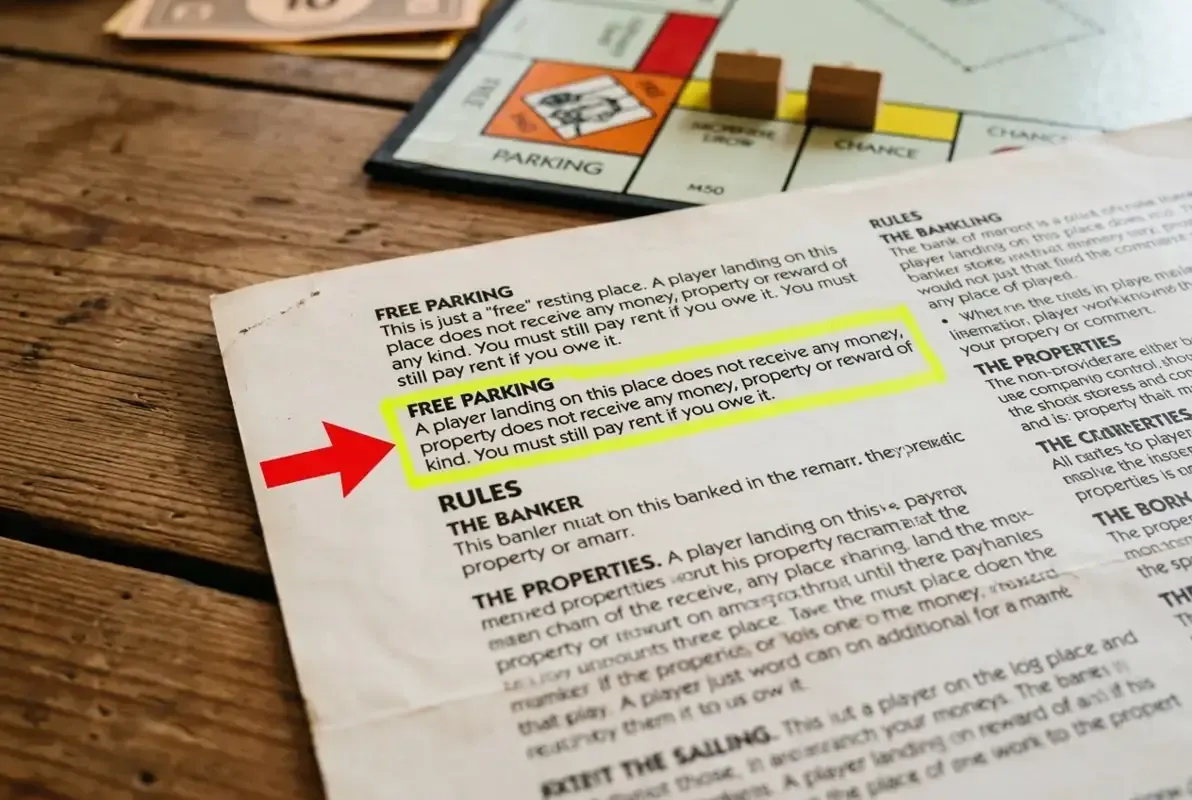
That one sentence shuts down ninety percent of disputes. My sister still argues anyway, but at least the evidence is on the table.
One table argument this solves: How much money do you start with in Monopoly? — the official $1,500 breakdown and why extra cash at setup breaks the economy.
What Does Free Parking Mean in Monopoly?
If there is no payout, what is the point of the square?
Think of the board as a financial minefield. By the time you reach the Free Parking side, you are surrounded by expensive orange and red properties — St. James Place through Kentucky Avenue. One bad roll can drain hundreds of dollars.
The free parking space monopoly designers placed there is simply a safe resting spot.
You land, you breathe, you end your turn. No rent owed. No Chance card. No Community Chest surprise. Your token parks while everyone else keeps sweating.
That makes it tactically interesting in a way most players miss. It is the only square on the board that cannot actively hurt your wallet on the turn you land there. Late game, when hotels line every monopoly, a lap through the danger zone without paying rent feels like a small miracle — even if nobody hands you cash for it.
Elizabeth Magie designed the original Landlord’s Game as a lesson in economic inequality. The modern Monopoly economy depends on money leaving player hands and disappearing into the Bank. Free Parking was never meant to be a lottery — it was meant to be a pause before the next rent bomb.
The Official Monopoly Free Parking Rule Explained
The official monopoly free parking rule fits into a broader pattern: corner spaces either punish you (Go to Jail), reward you (Go collects $200), or do nothing at all.
Free Parking falls firmly in the “do nothing” camp.
When your token lands there:
- You owe no rent to any player.
- You do not draw a Chance or Community Chest card.
- You do not pay a fine or tax.
- Your turn ends normally.
On your next turn, roll the dice and move forward like any other square. No doubles required. No escape fee. Unlike Jail, Free Parking never traps your token.
You can still buy houses on your color sets, trade deeds, bid at auctions, and collect rent from opponents who land on your properties. Business continues even while you rest on the corner.
| Action on Free Parking | Official Rule |
|---|---|
| Receive money from the Bank | No |
| Owe rent | No |
| Draw a card | No |
| Buy houses or trade | Yes |
| Collect rent from others | Yes |
| Must roll doubles to leave | No |
If your group plays house rules: Can you collect rent in Jail? — another corner-space myth that trips up most tables.
Monopoly Free Parking Money in the Middle (House Rules)
So where did the jackpot idea come from?
Families invented the monopoly money in the middle rules decades ago to add lottery-style luck. It spread because it feels fair — bad luck with taxes should mean good luck for someone else, right?
The most common version works like this:
- The Banker places a $500 bill in the center at setup.
- Every Income Tax, Luxury Tax, and “Get Out of Jail” fine goes into the pile instead of back to the Bank.
- The first player to land on Free Parking scoops the entire stack.
Players constantly ask: do you put taxes in the middle in monopoly? In these unofficial games, yes. Under Hasbro rules, no — taxes always return to the Bank.
At a neighborhood tournament I watched in 2019, the center pile hit $3,100 before anyone landed on the corner. The “winner” was the player who had been losing all night. She bought Boardwalk on her next lap and the game dragged another ninety minutes. Everyone cheered. I wanted to go home.
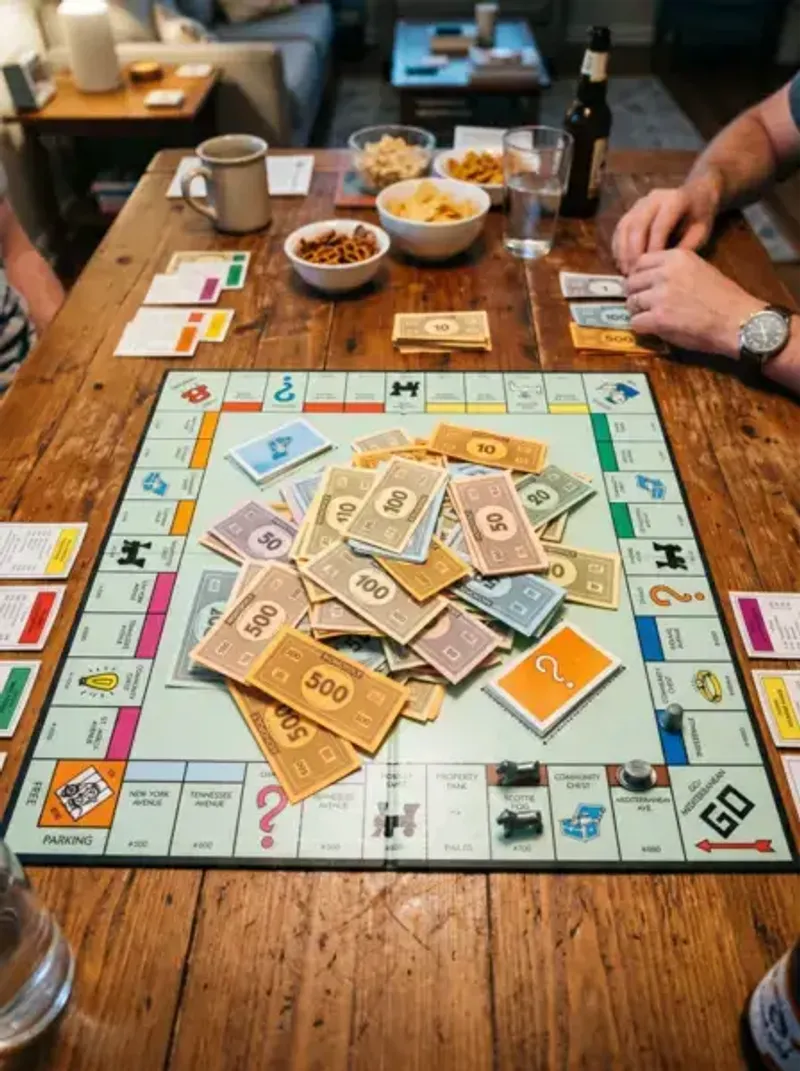
Some groups also throw in Chance and Community Chest fines. Others seed the pile with $500 and add $100 every time someone passes Go. None of it appears in the official rulebook.
Monopoly Money in the Middle Rules (Common Variations)
| House Rule Element | Typical Version | Official Hasbro |
|---|---|---|
| Seed money at start | $500 in center | None |
| Income / Luxury Tax | Goes to center | Goes to Bank |
| Jail fine ($50) | Goes to center | Goes to Bank |
| Chance / Chest fines | Sometimes center | Always Bank |
| Payout trigger | Land on Free Parking | No payout |
My grandma’s version included speeding-ticket cards in the pile but not school-tax cards — a distinction nobody could explain when I asked at age eleven. That is house rules in a nutshell: invented logic that feels right until you read the actual sheet.
Why the Center Jackpot Ruins the Game
Here is what most families never connect: the jackpot is why Monopoly feels like it takes six hours.
The game was designed by people who understood supply and demand. Money is supposed to leave circulation. Taxes drain it. Fines drain it. Rent transfers it between players until someone cannot pay. That cash shortage forces mortgages, fire sales, and eventually bankruptcies.
When you play with monopoly free parking money in the middle, you inject thousands of dollars back into the economy at random.
The player about to go bankrupt hits the corner, grabs $1,800, and survives two more hours. Properties that should have changed hands stay locked. Hotels stay standing. The endgame stalls.
Want a ninety-minute game night? Play official rules. Keep taxes in the Bank. Let Free Parking be boring.
The probability angle most guides skip: with fair dice, you land on any single space roughly 2.8% of the time. Free Parking is not a frequent stop — but when the jackpot finally pays, the cash injection is enormous relative to how rarely it triggers. One lucky hit can undo ten turns of rent pressure. That is not excitement; it is economic whiplash.
For broader context on how cash flow shapes wins and losses, see our Monopoly economics hub and strategy guides.
Frequently Asked Questions
Can you still buy houses while on Free Parking?
Yes. Your token resting on the corner does not freeze your finances. Buy houses on complete color sets, trade deeds, mortgage property, and collect rent — same as playing from Jail.
Do you have to roll doubles to leave Free Parking?
No. Jail requires an escape. Free Parking does not. Next turn: roll, move, play normally.
What happens to Chance card fines under official rules?
Speeding tickets, school taxes, and every other card penalty goes straight to the Bank. The center pile is a house-rule invention, not Hasbro standard. Confirm any disputed fine on the Wikipedia Monopoly gameplay page or the official PDF.
Is the Free Parking jackpot used in tournaments?
No. Competitive and tournament Monopoly formats follow official rules — no center pile, strict auction enforcement, timed rounds. The Monopoly FAQ covers other house rules that extend games unnecessarily.
Your Next Move
You now have the official answer and the ammunition to prove it.
Before your next game, announce you are playing by the book. Taxes go to the Bank. Free Parking pays nothing. Your opponents will bankrupt faster when cash stays scarce and your developed properties actually hurt.
For the full rules picture — setup, jail, auctions, and mortgages — visit our Monopoly Rules Hub or the complete Monopoly guide.
Does your family still seed the center with a $500 bill? Tell us the biggest jackpot you have ever seen on the Contact page — we feature reader stories in future guides.
Subscribe to The Dice & Deeds Briefing for rule updates, strategy notes, and new guides. No spam — just occasional tabletop tips from Dice and Deeds.
Questions
Frequently Asked Questions
Do you get money on free parking in Monopoly?
No. Under official Hasbro rules, landing on Free Parking does not award any money, property, or reward. The payout is always zero.
How much do you get for free parking in Monopoly?
Zero dollars. The official rulebook states that a player landing on Free Parking receives no money of any kind.
What happens when you land on Free Parking in Monopoly?
Nothing financial happens. Your turn ends. You owe no rent, draw no card, and pay no fine. It is a neutral rest space on the board.
Do you put taxes in the middle in Monopoly?
Not under official rules. Income Tax, Luxury Tax, and fines go to the Bank. The center jackpot is a house rule, not Hasbro standard.
Can you still buy houses while on Free Parking?
Yes. Like being in Jail, your business does not stop. You can buy houses, trade with other players, and collect rent while your token rests on the space.
Do you have to roll doubles to leave Free Parking?
No. On your next turn, roll and move normally. Free Parking does not trap your token the way Jail does.
What happens to Chance card fines under official rules?
Fines from Chance or Community Chest go directly to the Bank. They never go into a center pile unless your group plays a house rule.